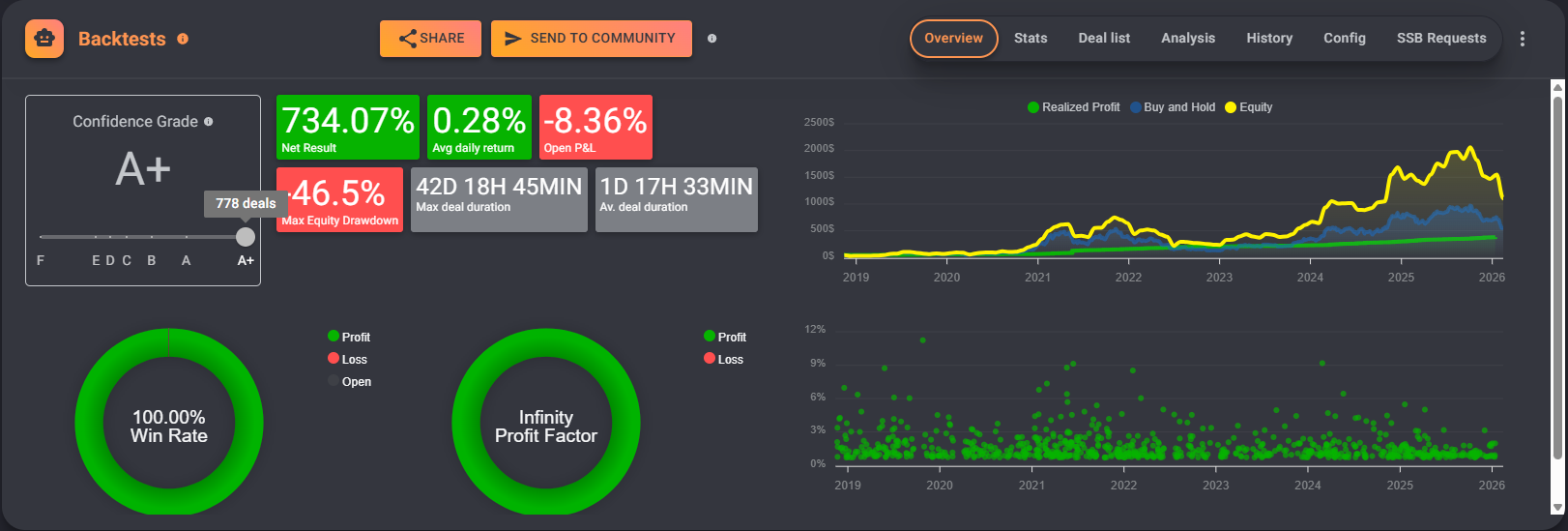
Recently, I posted about my short bot strategy, and in the meantime I was also working on a long leverage strategy. After many tests, I was unable to find a good Long strategy. Until I converted my current short strategy into a long leverage strategy. And strangely enough, with a few adjustments, the bot also worked for longs, and very well at that!
The Big Long is a BTCUSD long strategy designed for stable, repeatable profits in mixed market conditions. The strategy looks for short-term declines on the 15-minute chart and enters when the price shows signs of weakness but still has room to recover.
The strategy works best in sideways markets, slow downtrends, and periods when Bitcoin regularly retests support levels. The strategy uses multiple confirmation signals to avoid poor entry points and relies on a structured DCA system to improve the average entry price during deeper declines.
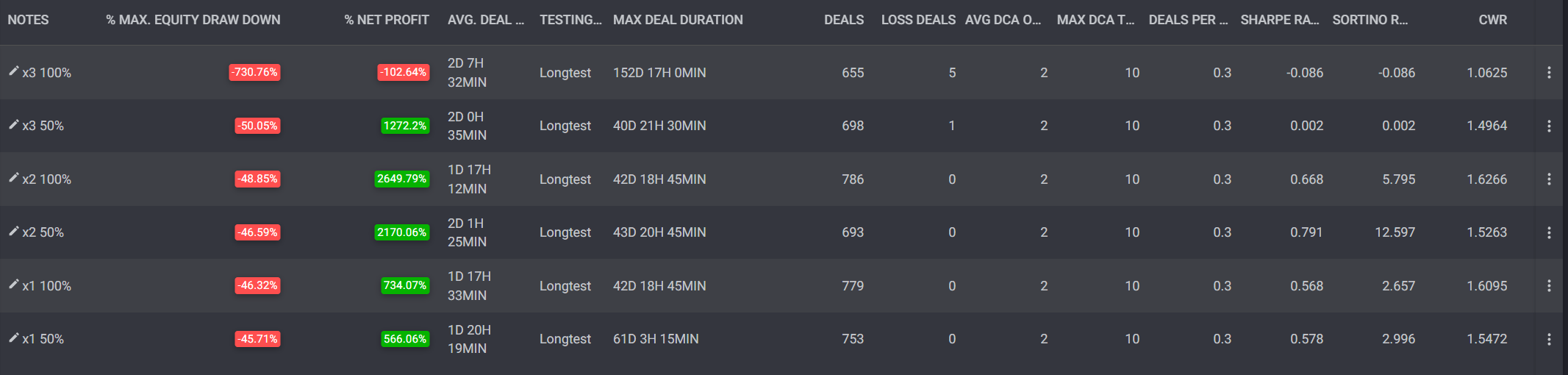
During backtesting, I noticed that you can go up to x3 or x4 on some exchanges without liquidations, but I find that a bit too risky.
Even at x1, it performs very well, so if you want to play it safe, that is also an option.
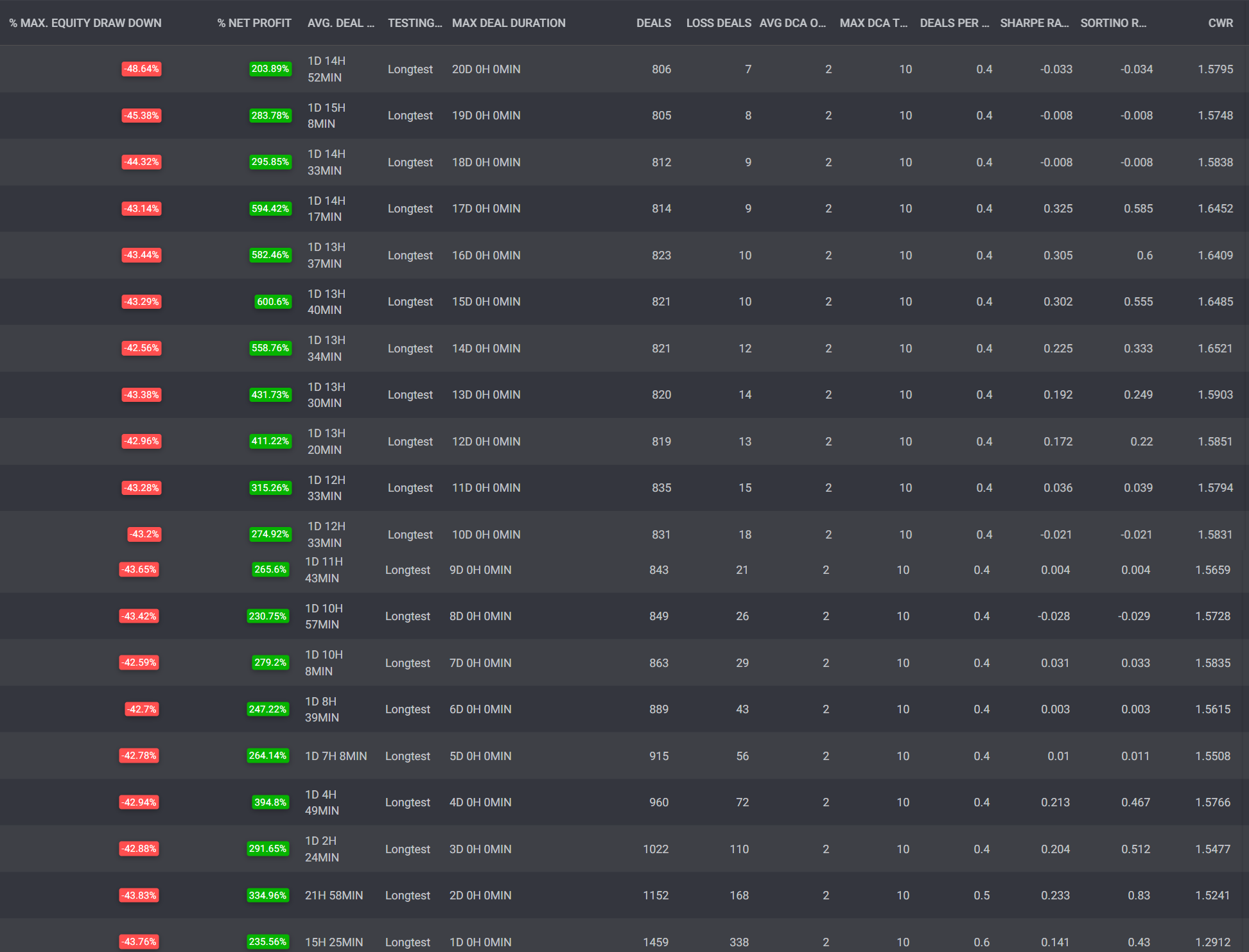
If you are not comfortable with the fact that the deals sometimes remain open for a long time (in my current backtest, there are 3 deals that were open for more than 30 days), you can build in an auto close of 7 to 9 days, which worked well during my backtesting.
Disclaimers:
This strategy is accompanied by a relatively large drawdown of approximately ~45%, which can normal for a DCA-based bot.
The bot deliberately holds on during short-term downtrends to take advantage of stronger rebounds, but traders should be comfortable with temporary fluctuations in equity.
As some trades can remain open for up to ~40 days, the strategy may accumulate funding fees when using leverage.
Traders should be aware that long holding periods on leveraged positions can become costly under certain market conditions.
Definetely need to watch for funding fees. Have you tried the close by timer?
Something else to watch is the equity curve, as you can see it mirrors the btc performance. That could mean the entries are not very specific, and much of the performance could be explained by btc bullish action over the years. Probably a good idea to try it on paper for some time.
Regarding the equity curve, that makes sense, doesn’t it? The bot makes a profit in BTC, and that is also used as input. So the value of the bot/funds rises or falls with the value of BTC. Or am I misunderstanding the equity curve?
In futures you cannot profit in base, even though technically you can leave part of the position open, you would need to pay funding fees etc. Regarding the equity curve, increasing when btc increases is totally normal, but what you would ideally want to see is that if btc decreases, the equity of the bot won’t decrease as much. If the equity of the bot increases and decreases in the same proportion as btc, that would be pretty much like opening positions at random times. In that case the strategy performance is 100% dependent on btc performance, it doesn’t have any inherent edge.
This is Coin-M futures, so in that case the profit is in Base (BTC).
If it had been USD Futures, you would have been right, but I deliberately chose Coin-M so that I could earn more BTC with my BTC.
So in this case, I think it makes sense that the equity curve follows the price of BTC, because that is the collateral/funds for the bot.
And because my realised profit keeps increasing, you can also see that the equity curve is growing exponentially as a result.
And just for fun, I created a second bot with a close by timer on 15D.
And I’ve been backtesting, and thanks to the timer, I need fewer DCA orders, which means I can also increase my BO/DCA size.
And in theory, after a while, the bots will diverge in terms of profit, so I will rebalance the funds between both accounts on a weekly/monthly basis.
And yes, I should really test it on paper, but that’s not how I work. I prefer to test it in real life with a small amount, and if something proves itself, I can always increase the investment.
Ok yes, in that case it would make sense. I have no experience with inverse futures, it’s good to know you can actually profit in base. I’d be interested how it goes with the live trading trial.
In which Timeframe and which timespan do you test the bot? It looks that it has a huge amount of deals, that always cost money. It that case fees might be an issue.
Maybe there could be a nice combination with this bot I created:
Testing period: from 14-11-2018, 17:00:00 to 14-2-2026, 20:15:00
Time Frame: 5 minutes
It’s true, there are a number of deals that remain open for a long time, and that can be quite expensive in terms of funding fees.
That’s why I now have two tests running:
The bot that automatically closes deals after 15 days. Fifteen days is still manageable in terms of funding fees.
Both bots now stop at 23:00 and start again at 10:00
Several long-term deals were started between 23:00 and 10:00.
I start and stop the bots using a Python script that runs on my NAS.
I will keep an eye on this in the coming weeks/months.
Just a quick update: the bots have now been running for a month and a half. We’ve already seen a few dips, and it’s usually when there’s a slight recovery from those dips that they start a trade (so I expect they’ll start another trade today or tomorrow).
Using a script running on my NAS, the bots switch off at 11 pm and start again at 10 am. I’ve just done a backtest, which meant that one trade didn’t start, but instead started a day later, so the position was open for a shorter period and I therefore paid lower funding fees.
The actual trade also required one less DCA to close. Unfortunately, this resulted in a lower profit, but it does provide greater safety.
(paper trade)
And the bot that automatically closes trades after 15 days hasn’t had to perform that automatic closure yet. Everything closes within a reasonable timeframe.
Every month, a small percentage of my DCA goes to these bots, and every month I ensure that the investment for both bots is equal again.
All in all, I’m very happy with this setup; they don’t initiate a huge number of trades, but they do secure nice profits. I’m curious to see how they’ll perform in the coming months.